Home About Us Products Quality Clientele Manufacturing Process Certificate Contact Us Feedback
LT XLPE Power Cables   Control Cables      LT PVC Power Cables    Control Cables     FR /FRLS / HR PVC Cables       House Wiring / Multicore Flexible / industial Cables Hook-up Wires      Submersible Cables      Telecommunication Cables       Co-axial Cables Instrumentation Cables     Computer Cables    Aerial Bunched Cables      TRS / TRS Braided Cables    Welding Cables    CCTV Cables    Cat-5 & Lan Cables     Moulded Plugs
 
 
LT XLPE Power / Control Cables.


XLPE is an abbreviation for cross-linked polyethylene or vucanized polyethylene. The basic material is low-density polyethylene. Polyethylene is theroplastic material consisting long chain of hysrocarbon molecules. Cross-linking o polyethlene takes place in theree-deminsional network. As such XLPE is non polar material which possesses high insulation resistance and dielectric strength and low dielectric loss.


Advantages of XPLE

Due to the excellent electric thermal machanicla and chemical properties of XPLE these cables are widely used by the customers replacing the conventional cables using PVC as insulating material. The various advantages of XLPE cables are given below.


1
Higher current ratings : It is possible to use one lower size of cable as compared to PVC.
2
Higher emergence overload withstand capacity. It can withstand overload temperature up kto 130'C because of better ageing properties and resistance to deformation under load.
3
Higher short circuit rating : XLPE can withstand short circuit temperatures up to 250'C whereas PVC cables can only withstand up to 160'C.
4
Enhanced life because dielectric losses are very small.
5
Jointing and terminations are very easy.
6
XLPE cables are not prone to fatigue damage due to vibrations or loading cycles.
7
Easy handling during installation because these cable are lighter in weight.
8
XLPE cable retain their flexibility down up to 40'C.
9
No elevation limit.
10
Better resistance to most chemicals such as ordinary acids, bases and oils.
11
PVC cables have distinct disadvantages regarding encironmental protection, if they burn they gives of corrosive gases. Although XLPE also burns but the combustion products, carbon dioxide and water, do not cause a damage. Moroverm it does not melt like polyethylene.

General Construction
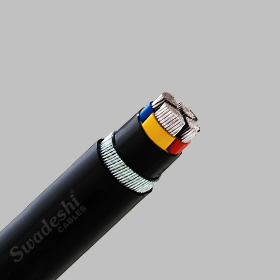
XLPE Cable are manufactured confirming to IS ; 7098 or as per customers requirement.

Conductor
The conductor of power cables is generally made from EC grade aluminium and annealed high conductivity copper is used for control cables. All cinductors confirm to IS :8130. Power Cables with copper conductor can also be supplied as per customer's requirment. The conductor are solid/ stranded/bunched as per the requirement.

Insulation
The consuctor is insulated with the XLPE compound by extrusion.


Properties
XLPE
PVC
Normal Continuous Operation temp. ('C)
90
70/85
Emergency Overload temp. ('C)
130
95/105
Short Circuit temp. ('C)
250
160
Chemical Resistance
Very good
Very good
Moisture Resistance
Very good
Very good
Fire Resistance
Good
Very good
Min. Installation ('C)
-40
0
Thermal Resistivity of Dielectric ('C cm/Watt)
350
600
Volume Resistivity of Dielectric (Ohm-cm)
10/17
10/13
Dielectric Constant
2.3
6
Break down volatge (Kv/mm)
40
20
Power factor at 50MhzHz
0.0008
0.1

Inner Sheath
The laid up cores are provided with the PVC inner sheath either by extrusion or by wrapping of plastic or proofed tapes. Single core cables do not hae inner sheath.

Armouring
Armouring is applied over inner sheath in case of multicore cables and over insulation in case of single core cables. In case the calculated diameter soesnot exceed 13mm, the armour consists of galvanized roound steel wires. Where the calculated diameter under the armour is greater than 13mm the armour generally consits of flat steel. If required the cable can be manufactured wth round steel wire calculated diameter of cable exceeds 13mm.

Outer Sheath
Outer sheath is applied by the required PVC comppound by extrusion over insulation in case of unarmoured single core cables, over inner sheath in case of unarmoured multicore cables & over armouring in case of armoured cables.

Routine Test
Tests carried out on each cables to check the requirement which are likely to vary during production.
1. Consuctor Resistance
2. High Voltage.
3. Armour Resistance (for mining Cables)

For identification of cores the following colour scheme is adopted.
Single Core
Red, Black, Yellow, Blue or Natural
Two Core
Red & Black.
Three Core
Red, Yellow & Blue
Four Core
Red, Yellow, Blue & Black.
Five Core
Red, Yellow, Blue, Black & Grey.
Six Cores and above
Two adjacent cores ( counting & direction core) in each layer. Blue & Yellow, remaining cores are Grey.
 
By printing nos. In numerals on the outer surface ot the core as per CI 10.3 of IS:7098 (Part-1)