Home About Us Products Quality Clientele Manufacturing Process Certificate Contact Us Feedback
LT XLPE Power Cables   Control Cables      LT PVC Power Cables    Control Cables     FR /FRLS / HR PVC Cables       House Wiring / Multicore Flexible / industial Cables Hook-up Wires      Submersible Cables      Telecommunication Cables       Co-axial Cables Instrumentation Cables     Computer Cables    Aerial Bunched Cables      TRS / TRS Braided Cables    Welding Cables    CCTV Cables    Cat-5 & Lan Cables     Moulded Plugs
 
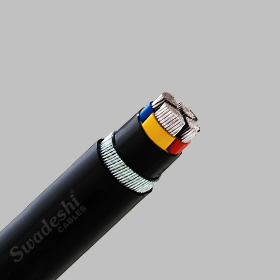
LT PVC Power / Control Cables.
 
 
brand, PVC insulated LT Heavy Duty cables are as per IS:1554 (Part-1) 1988 and are suitable for fixed installations.
 
CONDUCTOR : The most acceptable metals for conductors are copper and Aluminium due to their higher conductivity and ductility.
 
As copper has got higher affinity for sulphur, it corrodes in the atmosphere where sulphur fumes are present. In these conditions tinned copper should be used.
 
Aluminium oxide film which is always present on Aluminium conductor surface acts as a barrier and it protects the Aluminium conductor form corrosion in fumes laden atmosphere.
 
INSULATION : The PVC covering over Conductor is called insulation and is provided by extrusion process only. The insulated conductor is called core.
 
IS: 1554 permits two types of PVC insulation as Follows :
1) Insulation with TYPE A PVC Compound as per IS: 5831 which is suitable for 70°C continuous operation.
2) Insulation with TYPE C PVC compound as per IS: 5831 which is suitable for 85°C continuous operation.
 
The following colour code is used for identification.
 
Single Core
Red
Black
Yellow
or
Blue
Two Core
Red
and
Black
Three Core
Red
Yellow
and
Blue
Three & Half
Red
Yellow
Blue
and
Black
Four Core
Red
Yellow
Blue
and
Black
Five Core
Red
Yellow
Blue
Black
and
Grey
Six Core and above Two adjacent Cores. Blue and Yellow ( Counting and Direction Core) and remaining Grey in each layer. Or By printing numbers on each core.
 
LAYING UP : The cores are laid up with suitable lay. The Final layer always has a right hand lay i.e. if you look along the cable, the cores move to your right hand.
 
INNERSHEATH : Innersheath is provided over the laid up cores. it is provided to give circular shape to the cable and it provides bedding for the armouring.
 
IS: 1554 permits following two methods of applying the innersheath of any thermoplastic material i.e. PVC, Polyethylene, etc.
 
EXTRUDED INNERSHEATH : Here the innersheath is procided by extrusion of thermoplastic over the laid up cores.
 
This type of innersheath is generally provided in cables having round cores i.e. in control cables and in power cables up to 10 Sq.mm.size.
 
This type of the innersheath also acts as a water barrier between cores and outersheath. in case of a puncture in the outersheath the water can not reach to the cores and hence we recommend that cables for outdoor underground uses should have extruded innersheath.
 
ARMOURING : In case of armoured cables, generally steel wire/strip armouring is provided over the innersheath in mult-core cables and over the insulation in single core cables. it provides mechanical protection to inside cores and it carries earth return current in case of a short circuit of a core with armour.
 
As per IS: 1554 (part-1) 1988, round wire armouring is provided in cable, where calculated diameter under armour is up to 13 mm. Above this the armouring is either with roune wire or strip of size 4mm. x 0.80mm. As per strip construction is economical, the manufacturers always provide steel strip armouring unless wire armouring is specially specified.
 
In long run of cables and in case of mines, round wire armouring is must, as strip construction provides higher resistance to earth fault current and sometimes this current may not be sufficient to operate the circuit breaker in case of earth fault.
 
In mines, the resistance of the armour in on case should exceed the resistance of the main core by more than 33% for safety reasons. To achieve this, some times tinned hard drawn copper wires are required to be used along with galvanized steel wires. Sometimes two layers of steel wires are provided to give extra protection.
 
In case of single core armoured cables for use in ac circuits, the material for armouring has to be non magnetic, as in this case the return current is not passing through the same cable and hence it will not cancel the magnetic lines produced by he current. these magnetic lines which are oscillating in case of AC current will give rise to eddy current in magnetic armouring and hence armouring will become hot, and this may lead to the failure of the cable. generally hard drawn aluminium wires/strip are used for armouring in this case.
 
OUTERSHEAT : The PVC convering on armouring in case of armoured cables and over the innersheath in caseof unarmoured cables is called outersheath.
 
IS: 1554 specifies nominal and minimum thickness of outer sheath for unarmoured cables and only minimum thickness of outer sheath for armoured cables.
 
it permits the following types of outer sheath PVC Compounds.
 
1) Outer sheath with Type ST1PVC Compound as per IS:5831, which is suitable for 70° C Continuous opration.
2) Outer sheath with Type ST2PVC Compound as per IS:5831, which is suitable for 85° C Continuous opration.
 
In the modern power, Chemical, Fertiliser and Cement Plants many PVC cables are bunched in the cable shaft or on cable trays. in case of fire in these cables, the fire becomes self sustaining. moreover due to the burning of PVC a dense corrosive smoke is emitted which makes fire fighting very diffcult, due to poor visibility and toxic nature of the smoke. HCL content of the smoke, not only damages other costly equipment lying nearby, but also penetrates the RCC and corrodes the steel reinforcement. Due to this there is an extensive damage of the property.
 
To remove these deficienciencies FRLS i.e. Fire Retardant Low Smoke PVC was developed.
 
If required, we can provide Fire Retardant Low Smoke (FRLS) PVC inner sheath and /or outer sheath. this PVC compound, apart from meeting the requirments of type ST2 as per IS: 5831, has got better fire retardant properties and it emits lower smoke and acid fumes when it catches fire.
 
TESTS : Testing is a very important part of cable manufacture and all raw materials and finished cables must be thoroughly tested to ensure the quality of cables. has a well equipped test fields and electrical, mechanical and chemical laboratories capable of carrying out all tests, which are required as per relevant specifications. The most modern testing equipment is installed in these laboratories.
 
The following tests are carried out on each and every length of cables before it leaves the factory.
 
(A) Conductor Resistance Test : The tests ensure that conductor resistance is within the specified limit, thereby verifying that the continuity of conductor is maintained throughout the cable length and that the conductor has the required electrical section DC. resistance is measured at room temperature and is then corrected to standard reference temperature of 20°C.
 
(B) High Voltage Test : This test ensures that insulation will safely withstand the rated voltage with permissible variation in normal operation.
 
CABLE CODE : The following codes are used for designating the cables as per IS: 1554.
 
CONSTITUENT
CODE LETTER
COPPER CONDUCTOR
--
ALUMINIUM CONDUCTOR
A
PVC INSULATION
Y
STEEL ROUNDWIRE ARMOUR
W
STEEL STRIP ARMOUR
F
STEEL DOUBLE ROUND WIRE AROMOUR
WW
STEEL DOUBLE STRIP ARMOUR
FF
PVC OUTER SHEATH
Y
COPPER CONDUCTOR, ROUND WIRE ARMOURED AND PVC SHEATHED CABLE
YWY
ALUMINIUM CONDUCTOR, STEEL STRIP ARMOURED AND PVC SHEATHED CABLE
AYFY
 
The weights of the cables mentioned in the following tables are approximate and given for guidance only. They should never be used as criteria to check the lengths of the cables supplied. The best way to check the length of thesupplied cable is by resistance only. Take the resistance of the full drum and divide the reading by the resistance of 1 mtr. length. To decide the size of the conductor, particularly that of the sector shaped conductor, we recommend the following method Take weight of a small conductor piece and measure its weight in grams. Then find out the weight of the conductor in gms per metre length. Divide it by 2.7 in case of Aluminium and by 8.9 in case of Copper. It will give the area of the conductor in sq. mm.